

Machining and Finishing Operations for Investment Cast Components
Precision investment casting often requires secondary machining to reach a component’s final functional dimensions. At Plasmaterm, this is carried out in our own machining workshop, in Târgu Mureș, Romania, as an integrated step in the same production flow as the casting itself — not by an external subcontractor.
Machining as Part of the Investment Casting Process
Investment casting produces components close to their final geometry, reducing the material that must be removed downstream. Many functional features still require precision finishing before assembly or delivery.
Unlike a contract CNC machining company, Plasmaterm’s machining workshop exists to prepare its own castings for final application — through conventional machining operations including drilling, turning, milling, threading and surface finishing. This integration reduces lead time, simplifies production and keeps quality control under one system from melt to finished part.
Machining and Finishing Operations
The machining workshop performs the operations needed to turn a precision casting into a ready-to-use component:
- Drilling
- Conventional Milling
- Conventional Turning
- Thread Cutting
- Boring
- Reaming
- Deburring
- Surface Grinding
- Surface Finishing
- Cleaning of Casting Residues
- Machining of Critical Functional Dimensions
Every operation is carried out in accordance with the customer’s drawings and quality requirements.


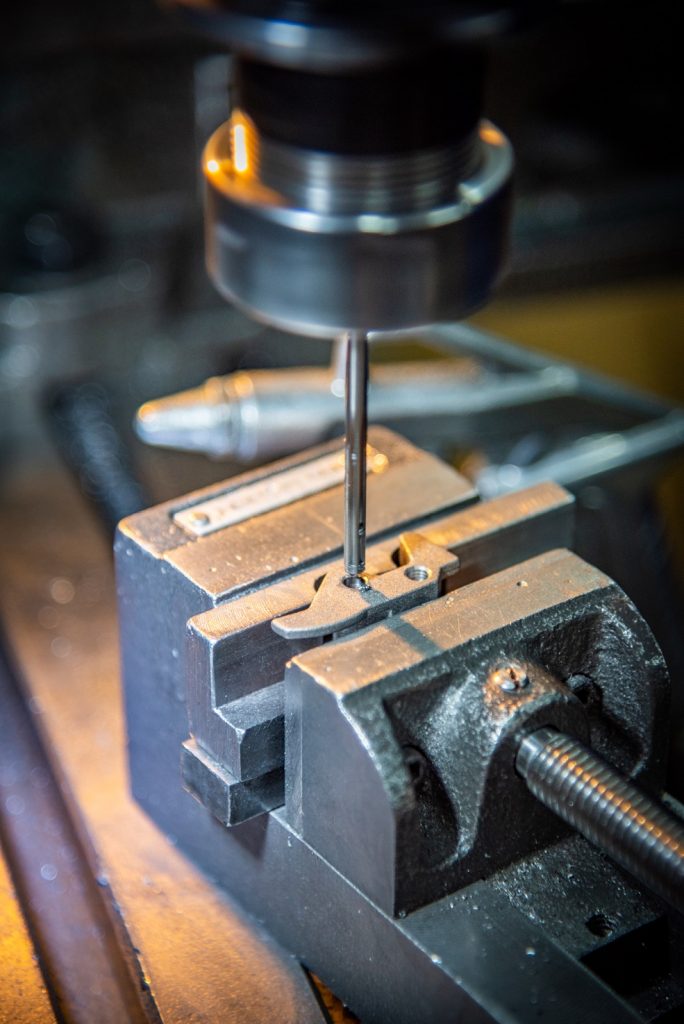


Machinig method
Method Description
Precision turning of investment-cast components to achieve tight dimensional tolerances, excellent concentricity, and high-quality functional surfaces. Turning is used to finish rotational features such as shafts, diameters, shoulders and sealing surfaces, ensuring that cast parts meet customer specifications while minimizing material removal and preserving the advantages of investment casting.
Milling is used to machine investment cast parts with high dimensional accuracy, creating flat surfaces, slots, pockets, steps and other functional geometries that cannot be produced directly during casting. Our machining process transforms near-net-shape castings into fully functional components ready for assembly while maintaining cost efficiency.
Precision drilling and tapping provide accurately positioned holes and threaded features on investment cast components. Whether for mounting, fastening or assembly purposes, these operations ensure reliable fit, repeatability and compliance with customer drawings, allowing cast parts to be delivered as ready-to-install components.
Surface grinding is applied where exceptional flatness, parallelism and surface finish are required. This finishing operation improves the accuracy of critical contact surfaces on investment cast components, making them suitable for demanding mechanical assemblies and precision engineering applications.
Cylindrical grinding delivers outstanding dimensional accuracy, roundness and surface quality on shafts, bores and other cylindrical features. It is used for investment cast components with tight tolerance requirements, providing smooth functional surfaces for bearings, sealing areas and precision fits.
Electrical Discharge Machining (EDM) enables the production and finishing of complex geometries that cannot be achieved by conventional cutting methods. At Plasmaterm, EDM is primarily used to calibrate non-cylindrical cavities, internal profiles and intricate features on investment cast components after casting, ensuring precise dimensions and repeatability. The technology is also an essential part of our in-house tooling capability, allowing us to manufacture high-precision dies, inserts, fixtures and other production tools.
Our CNC milling capability is dedicated exclusively to the in-house production of tooling used throughout the investment casting process. Precision-machined dies, fixtures, gauges and production equipment are manufactured internally, enabling faster tool development, better process control and greater flexibility when introducing new components or optimizing existing production.
Why Integrate Casting and Machining
Combining investment casting and conventional machining in one facility gives customers:
- One manufacturing partner
- Reduced logistics
- Shorter production lead times
- Improved communication
- Consistent dimensional control
- Simplified supplier management
- Complete traceability throughout production
- Ready-to-use finished components
Instead of shipping castings out to an external machining supplier, every finishing operation is coordinated inside a single production workflow.
| Industrial Machinery | Machining of wear components, housings, shafts, brackets and functional machine parts to achieve precise dimensions, tight tolerances and high-quality bearing or sealing surfaces for reliable long-term operation. |
| Automotive | Precision machining of prototype, pre-series and small-series components, ensuring dimensional accuracy, repeatability and compliance with customer drawings for validation and production support. |
| Railway | Finishing of internal mechanical components, mounting brackets, fixings and safety-related parts requiring consistent tolerances, reliable fit and durable surface quality. |
| Defence | Finish machining of P690 D1/D2 investment castings and other specialised components according to customer drawings, with strict dimensional control, traceability and high-quality surface finishes. |
| Hydraulics | Precision machining of sealing surfaces, bearing seats, valve bodies and flow-critical features where surface finish and geometric accuracy are essential for leak-free performance and operational efficiency. |
| Food Processing | Hygienic machining and surface finishing of stainless steel components, minimising roughness and facilitating easy cleaning while meeting demanding sanitary and corrosion-resistance requirements. |
| Textile Machinery | Machining of wear-critical guide elements, rollers, mounting features and structural components to ensure smooth operation, long service life and reduced maintenance in continuous production environments. |
| High-Security Locking Systems | High-precision machining of locking components, mounting interfaces and functional features where tight tolerances, repeatability and reliable assembly are essential for security-critical applications. |
Quality Assurance
Every machined component is inspected against the customer’s specification before delivery. Quality control includes:
- Dimensional inspection
- Thread verification
- Surface finish inspection
- Visual inspection
- Functional verification
These inspections are part of Plasmaterm’s ISO 9001:2015 quality management system, with full production traceability.
FAQ
Do you provide standalone CNC machining services?
No. Our machining workshop finishes investment cast components manufactured by Plasmaterm. We do not operate as a general subcontract CNC machining supplier.
Do you machine components produced by other foundries?
Our machining operations are primarily intended for investment castings manufactured in-house. Contact our engineering team to discuss a specific requirement.
Why combine casting and machining?
Integrating casting and machining under one roof reduces lead times, minimises logistics, improves dimensional consistency and simplifies supplier management.
Do you use CNC machining?
Yes — primarily to manufacture wax injection tooling, machining fixtures and production devices used in the casting process. CNC machining is not offered as a standalone production service.